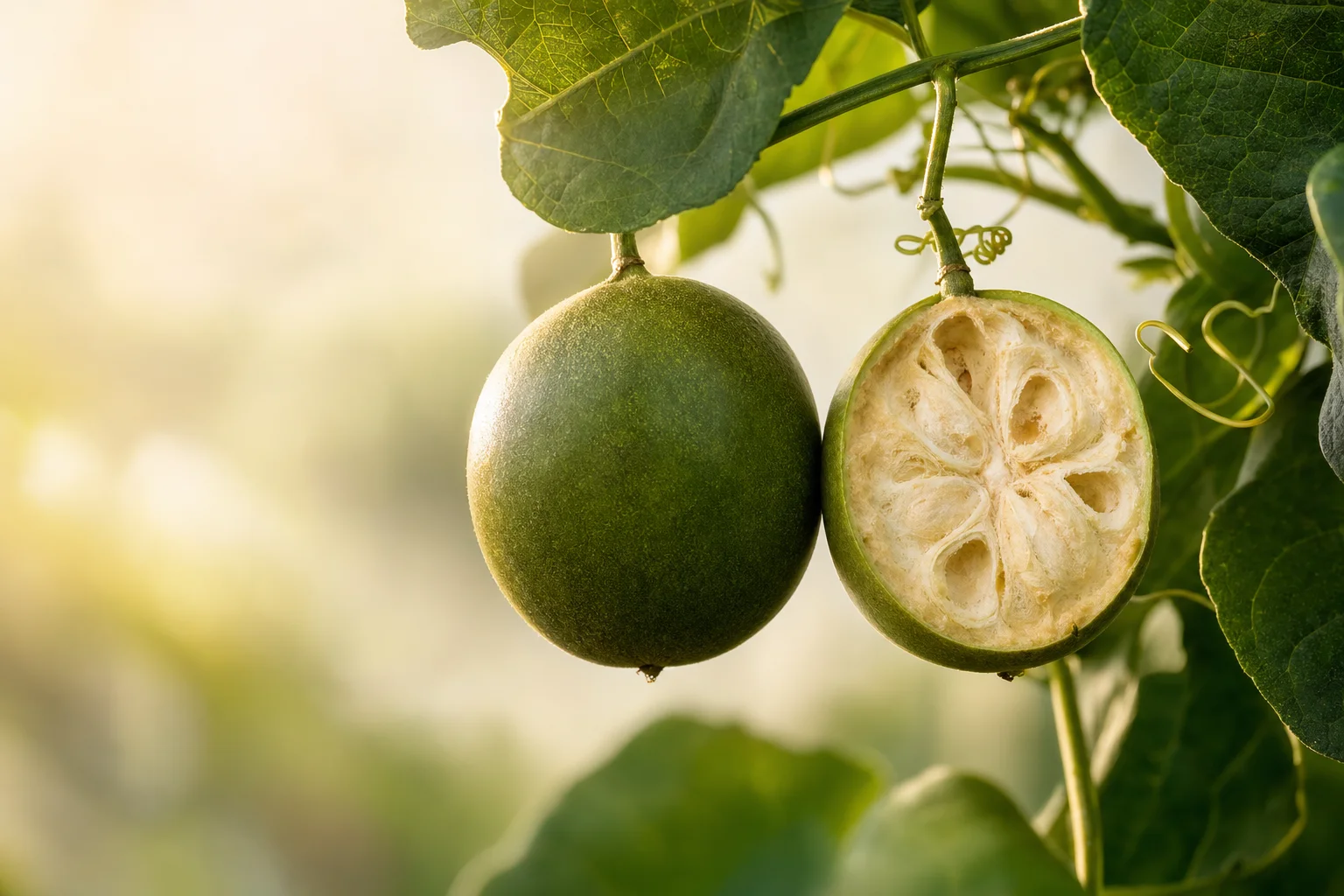
Monk fruit (luo han guo) is a small green melon that has been used as a sweetener for centuries. What makes it remarkable is simple to state and fascinating to unpack: it tastes intensely sweet, yet it has a true glycemic index of zero.
Sweetness without sugar: the mogroside story
Most sweet things are sweet because of sugars — sucrose, glucose, fructose. Monk fruit is different. Its sweetness comes from a family of natural compounds called mogrosides (the headline one is Mogroside V). These are triterpene glycosides, not simple sugars, and that single fact explains almost everything else about how monk fruit behaves in the body.
Why the glycemic impact is zero
When you eat monk fruit, the mogroside molecules pass through the stomach and upper digestive tract essentially intact. The body doesn't have the enzymes needed to break down their complex structure for energy. Because no glucose or other blood-sugar-raising carbohydrate enters the bloodstream along the way, monk fruit registers a true GI = 0 and doesn't prompt the insulin response that sugar does.
The short version
Monk fruit is sweet because of mogrosides, not sugar. The body can't metabolize mogrosides for energy, so they pass through without raising blood glucose — a true glycemic index of zero.
150–250x sweeter than sugar — so you use a whisper of it
Mogrosides are intensely potent: monk fruit extract is roughly 150 to 250 times sweeter than table sugar. That means it's used in micro-doses — a tiny fraction of the weight you'd need in sugar to hit the same sweetness. That micro-dosing turns out to matter a lot for how comfortable it is to consume.
Gentle on digestion
Bulk sugar alcohols and fibers have to be used in large amounts to sweeten, and because they aren't fully absorbed they can pull water into the colon and ferment, which is what causes the familiar bloating and discomfort. Monk fruit sidesteps this entirely: because the sweetness is so concentrated, the actual physical mass entering your system is tiny, so there are no meaningful fluid shifts and a very high digestive tolerance.
Friendly to your teeth
Cavities start when oral bacteria such as Streptococcus mutans ferment sugars and produce acid that erodes enamel. Those bacteria can't recognize or ferment mogrosides — to them, monk fruit is invisible as a food source. No fermentation means no acid drop, which is why monk fruit is considered non-cariogenic (tooth-friendly).
Standard sugars
Bacteria ferment them
The byproduct is acid that lowers mouth pH and strips minerals from enamel.

Monk fruit
Nothing to ferment
Oral bacteria cannot break down mogrosides, so no enamel-eroding acid is produced.
Why Swezee uses it
Monk fruit is one of the high-intensity sweeteners in the Swezee blend. It brings clean, powerful sweetness in a tiny dose. In the next articles we'll look at its partner, stevia, and then at why the smartest sweeteners are teams rather than a single ingredient.